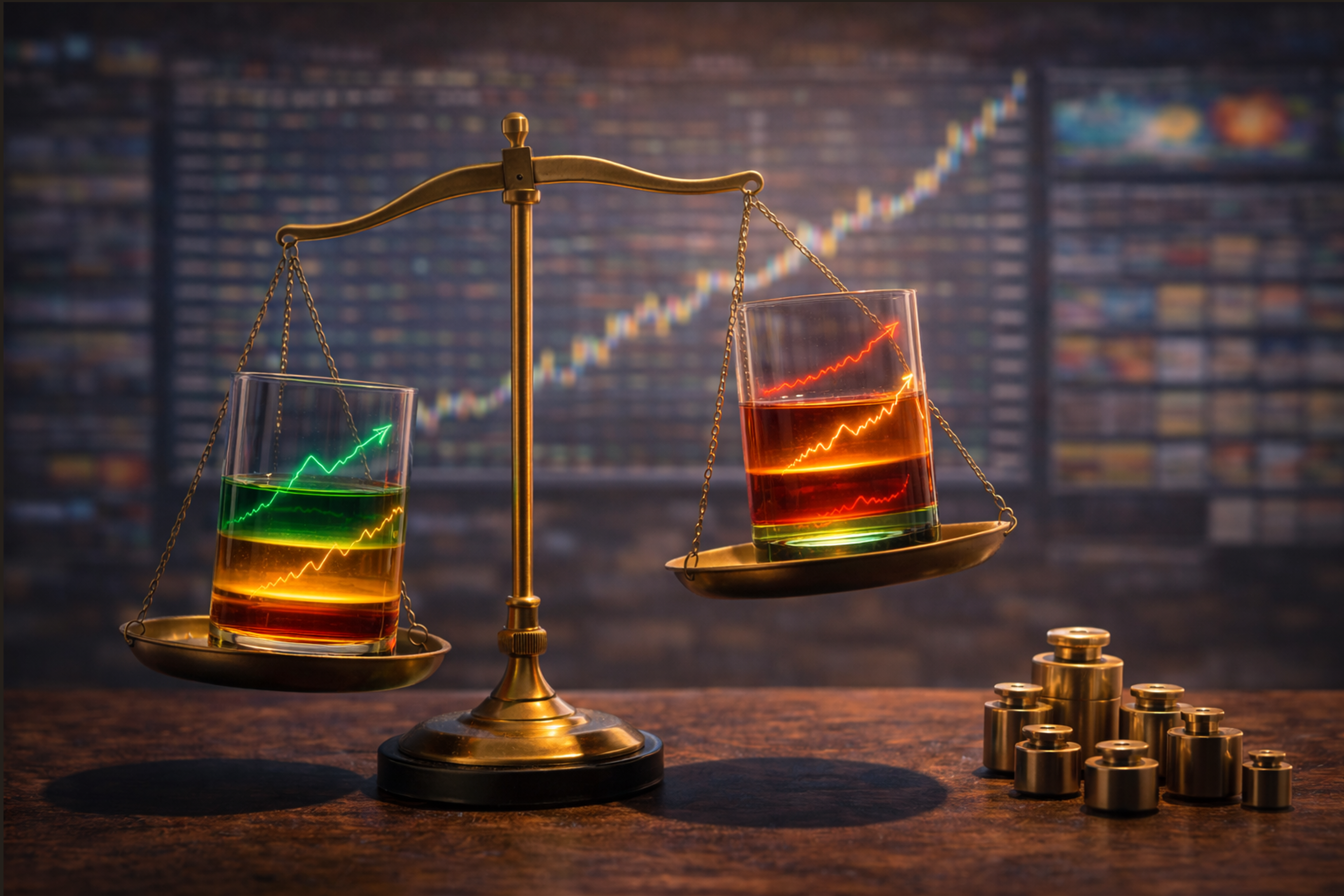
When Views Meet the Portfolio
When a Scenario Touches the Portfolio
A portfolio is not just a collection of assets. It is a statement about which futures you are prepared for. That statement exists whether you have made it explicit or not, and it shows up in outcomes long before it is ever written down.
Previously, we made weights visible. Every investor carries a set of probabilities across possible worlds, some chosen deliberately and others inherited from the market. This week, we take the next step and ask what those weights actually do in practice. At some point, a view has to connect to something you hold. Otherwise, it remains a story with no consequences.
Once that connection is made, something more concrete emerges. A portfolio is not just exposed to scenarios. It can be expressed as a set of weights across them, even if those weights were never assigned explicitly.
Portfolios Are Already Running Scenarios
It is tempting to think of scenarios as something layered on top of a portfolio, a tool for analysis that sits apart from the assets themselves. In reality, the portfolio is already doing this work. Every allocation reflects a set of implicit bets about how the world will evolve.
Holding long-duration bonds expresses a view on rates and inflation. Owning cyclicals expresses a view on growth. Concentration in a single theme reflects a view on how one version of the future compares to the alternatives. These exposures do not require a formal framework to exist. They are embedded in the structure of the portfolio and they shape outcomes regardless of whether they are acknowledged.
The difference is visibility. Without a framework, these exposures remain implicit. You experience them through performance, but you do not always see them ahead of time or understand how they relate to the views you think you hold.
A Scenario Without a Mapping Is Just a Story
We hear narratives constantly. Growth will reaccelerate. Inflation will persist. Central banks will pivot. These statements help organize thinking, but they are incomplete on their own.
A narrative becomes useful only when it connects to something concrete. What would actually have to happen in markets for that story to be true, and which assets would respond? What moves, and in which direction? Without answers to those questions, the narrative remains detached from the portfolio.
Every scenario implies a pattern of returns. It has a shape that reflects how different assets tend to behave when that world unfolds. Growth surprises tend to benefit some exposures and challenge others. Persistent inflation shifts the distribution in a different direction. Changes in liquidity can bring new relationships to the surface.
You do not need a perfect model to see this. You only need to translate the story into directional consequences. Without that translation, scenarios remain abstract. With it, they become a way to describe what a portfolio is actually positioned for.
The Translation Layer
This is the missing layer between views and portfolios. A scenario is a description of a possible world, and a portfolio is a collection of exposures. The bridge between them is a mapping that shows how that world would express itself across assets.
One way to think about this is as a signature. Each scenario has a signature, a pattern of expected returns across the things you can hold. Each portfolio also has a signature, a pattern of sensitivities to the same underlying forces. When both are expressed in the same language, they can be compared in a meaningful way.
At that point, the portfolio stops looking like a list of assets and starts looking like a distribution. Each holding contributes, directly or indirectly, to a set of implied weights that describe how much of the portfolio is positioned for one world versus another. The mapping is not perfect and it is not precise, but it is consistent enough to be useful.
Once this view is available, the focus shifts. The question is no longer what the portfolio holds, but what it is positioned for. That is the comparison that matters.
Alignment and Mismatch
If the portfolio’s implied weights line up with the scenarios you believe in, then you are positioned for those outcomes. If they do not, then you are running a different set of scenarios than the ones you think you are. This is where the framework becomes more than descriptive.
Most investors do not lack views. They lack alignment between those views and their positioning. That gap is not abstract or philosophical. It can be observed directly once both sides are expressed in the same terms. This gap shows up in familiar ways. You may feel confident in a thesis but see little impact in your returns when it plays out. You may experience drawdowns that do not match your stated risks or expectations. These outcomes are often attributed to timing or noise, but they frequently reflect something simpler.
It is not always a failure of the view. It is often a mismatch between what you believe and what you are actually positioned for. The portfolio is expressing a different set of weights than the ones you would assign if you were starting from a blank page.
Why This Matters
This is the point where the framework moves from interpretation to decision-making. Once you can see the implied weights, you are no longer reacting to outcomes without context. You are deciding whether the portfolio you have is consistent with the futures you believe in.
That creates a set of choices. You can adjust the weights of your scenarios, which changes your view of the world. You can adjust the composition of your portfolio, which changes how that view is expressed. Finally, you can accept the mismatch as intentional, recognizing that diversification, constraints, or uncertainty justify holding exposures that do not fully align.
The key difference is that it becomes a choice rather than an accident. Without visibility, you are left explaining results after the fact. With it, you can shape positioning in advance and understand the consequences of that positioning before they arrive.
The Next Step
Even if you never formalize scenarios, you are already running them. Every portfolio is a blend of possible worlds, expressed through positions that carry implicit weights. The question is not whether you have scenarios. It is whether you can see them clearly enough to describe what they imply. At that point, the problem reduces to two questions that sit at the center of every investment decision. What do you believe? What are you positioned for?
Most of the time, those questions are considered separately. Views are discussed in narrative terms, while portfolios are evaluated through allocations and performance. The connection between them is assumed rather than observed. Bringing them into the same frame makes that connection visible. It turns a vague sense of alignment into something that can be examined directly.
And once you can see that relationship clearly, another question begins to emerge. Not just what you believe or how you are positioned, but whether those positions reflect something else entirely.